



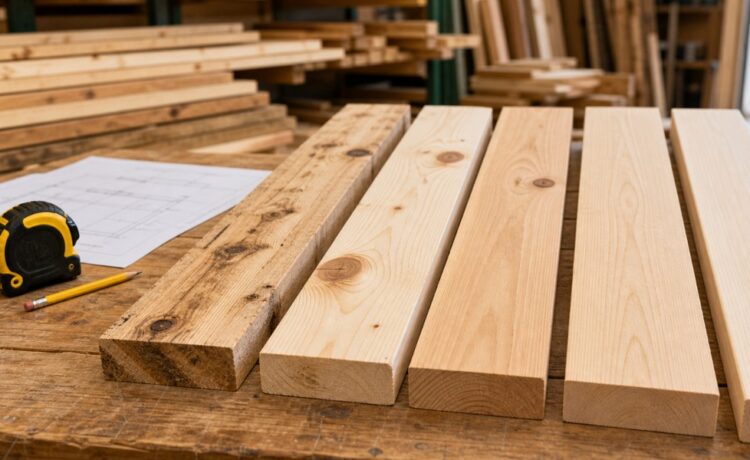
Choosing lumber can feel confusing when every board looks a little different. Some boards are smooth and clean. Some have knots, wane, cracks, or rough edges. Some are meant for framing. Others are better for furniture, trim, shelves, or outdoor projects.
Lumber grade helps you understand what a board is best used for. It tells you about strength, appearance, and quality. The right grade depends on what you are building, where the wood will be used, and how much of it will be seen.
Start With the Project
Before choosing a lumber grade, ask one question. What does the wood need to do?
If the lumber will support weight, such as wall studs, floor joists, beams, rafters, or deck framing, strength matters most. You need structural lumber. If the lumber will be visible, such as shelving, furniture, cabinets, trim, or decorative walls, appearance matters more.
A hidden framing board does not need to look perfect. A tabletop or cabinet face should look cleaner.
Structural Lumber Grades
Structural lumber is graded for strength. It is often used in framing and construction. Common grades include Select Structural, No. 1, No. 2, and No. 3.
Select Structural is higher quality and stronger, with fewer defects. It is used when strength and reliability are important.
No. 1 lumber is strong and usually has fewer knots and defects than lower grades. It can work well for projects where structure and appearance both matter.
No. 2 lumber is very common for framing. It allows more knots and imperfections, but it is still widely used for general construction when allowed by the building plan.
No. 3 lumber has more defects and is usually used for less demanding projects where appearance and strength are not the top priority.
For serious structural work, always follow building codes, plans, and span tables. Guessing is not a good idea when the wood supports weight.
Appearance Lumber Grades
Appearance-grade lumber is chosen for how it looks. These boards usually have fewer knots, smoother grain, and cleaner surfaces. They are often used for furniture, trim, paneling, shelving, and visible projects.
Select or clear grades are best when you want a clean finish. Common grades may have more knots, color variation, or character. That is not always bad. For rustic shelves or decorative projects, knots can add warmth and style.
The key is knowing whether defects will bother you. A knot in a hidden frame is fine. A large knot in the middle of a cabinet door may not be.
Outdoor Projects Need Extra Care
If the project will be outside, grade is only part of the decision. You also need the right wood type and treatment. Decks, fences, pergolas, raised beds, and posts face moisture, sun, insects, and soil contact.
Pressure-treated lumber is common for outdoor structural work. For posts or wood near the ground, look for lumber rated for ground contact. For decking boards, choose wood that is straight, stable, and suitable for foot traffic.
Cedar, redwood, and some hardwoods are also used outdoors because they have natural resistance, but they can cost more.
Check Each Board Before Buying
Even lumber with the same grade can vary. Look down the length of the board to check for bowing, twisting, cupping, or warping. Avoid boards with large splits, loose knots, severe wane, or damage where strength matters.
For visible projects, compare color and grain. Boards from the same stack can still look different once finished.
Match Grade to Budget
Higher grades usually cost more. That does not mean every project needs the best grade. Use higher-grade lumber where it will be seen or where strength is critical. Use standard framing grades where the boards will be covered.
Final Thoughts
The right lumber grade depends on purpose. Choose structural grades for strength. Choose appearance grades for visible work. Choose treated or naturally durable wood for outdoor projects.
A good board is not always the most expensive one. It is the one that fits the job. When you match the lumber grade to the project, the work looks better, lasts longer, and wastes less money.
This post was written by a professional at Anawalt Lumber. Anawalt Lumber is a family-owned lumber yard and hardware store serving Los Angeles for over a century. Known for quality lumber, contractor supplies, Hollywood hardware store, and a full-service nursery, Anawalt provides personalized service for homeowners and licensed contractors. From job pricing and bulk discounts to special-order materials with fast delivery, Anawalt is your trusted local building supply partner in Malibu, West LA, and Hollywood.

Simple Design Strategies for Blending Texture and Color in Kitchen Cabinets

A kitchen's personality leaps out at you before the first meal is ever cooked, and it starts with the cabinets....

Slab Repair vs. Replacement: Making the Right Decision

Concrete slabs are used for driveways, patios, floors, and foundations. Over time, they can crack, sink, or wear down. When...

Five Reasons Why Roaches Thrive in Indianapolis, IN Homes During the Winter


Most people assume pest problems decrease when temperatures drop. This may be true for some outdoor insects, but cockroaches behave...


The Role of Gutters in Preventing Foundation Damage
Gutters are more than just a component of your roof-they are a critical part of protecting your home's foundation. Properly...